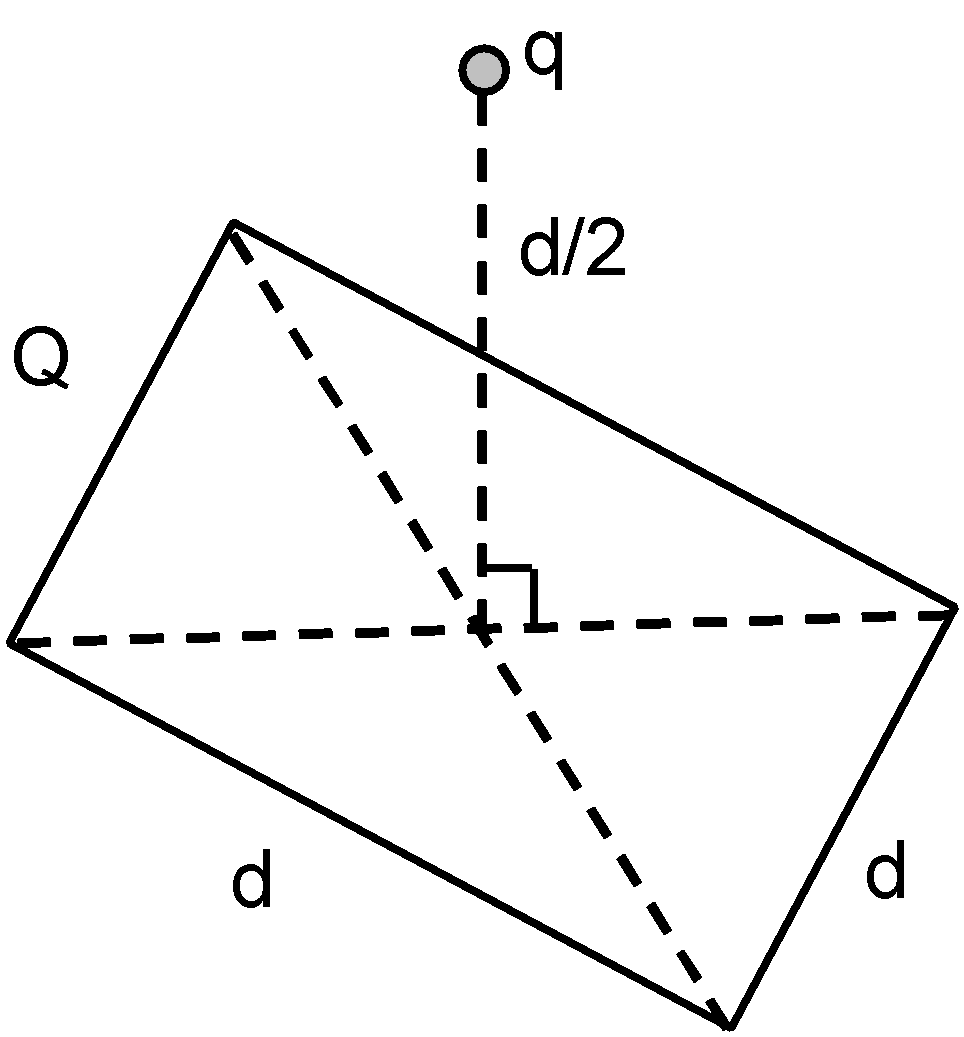
A square of side d, made from a thin insulating plate, is uniformly charged and carries a total charge of Q. A point charge q is placed on the symmetrical normal axis of the square at a distance d/2 from the plate. How large is the force acting on the point charge?
Text Solution
Verified by ExpertsAccording to Newton’s third law, the insulating plate acts on the point charge with a force of the same magnitude (but opposite direction) as the point charge does on the plate. We calculate the magnitude of this latter force.
Divide the plate (notionally) into small pieces, and denote the area of the i th piece by Δ A i . Because of the uniform charge distribution, the charge on this small piece is
Δ Q i =  Δ A i
Δ A i
and so the electric force acting on it is Fi = Ei - Qi, where Ei is the magnitude of the electric field
produced by the point charge q at the position of the small piece.
The force acting on the insulating plate, as a whole, can be calculated as the vector sum of the forces
acting on the individual pieces of the plate. Because of the axial symmetry, the net force is
perpendicular to the plate, and so it is sufficient to sum the perpendicular components of the forces:
F = 
where θ i is the angle between the normal to the plate and the line that connects the point charge to the
i th piece of it.
The sum in the given expression is nothing other than the electric flux through the square sheet
produced by the point charge q:
ψ = 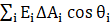
and can be evaluated as follows.
Let us imagine that a cube of edge d is constructed symmetrically around the point charge (see figure). Then, the distance of the point charge from each side of the cube is just d/2. According to Gauss’s law, the total electric flux passing through the six sides of the cube is q/ε 0 and so the flux through a single side is one-sixth of this:
ψ = 
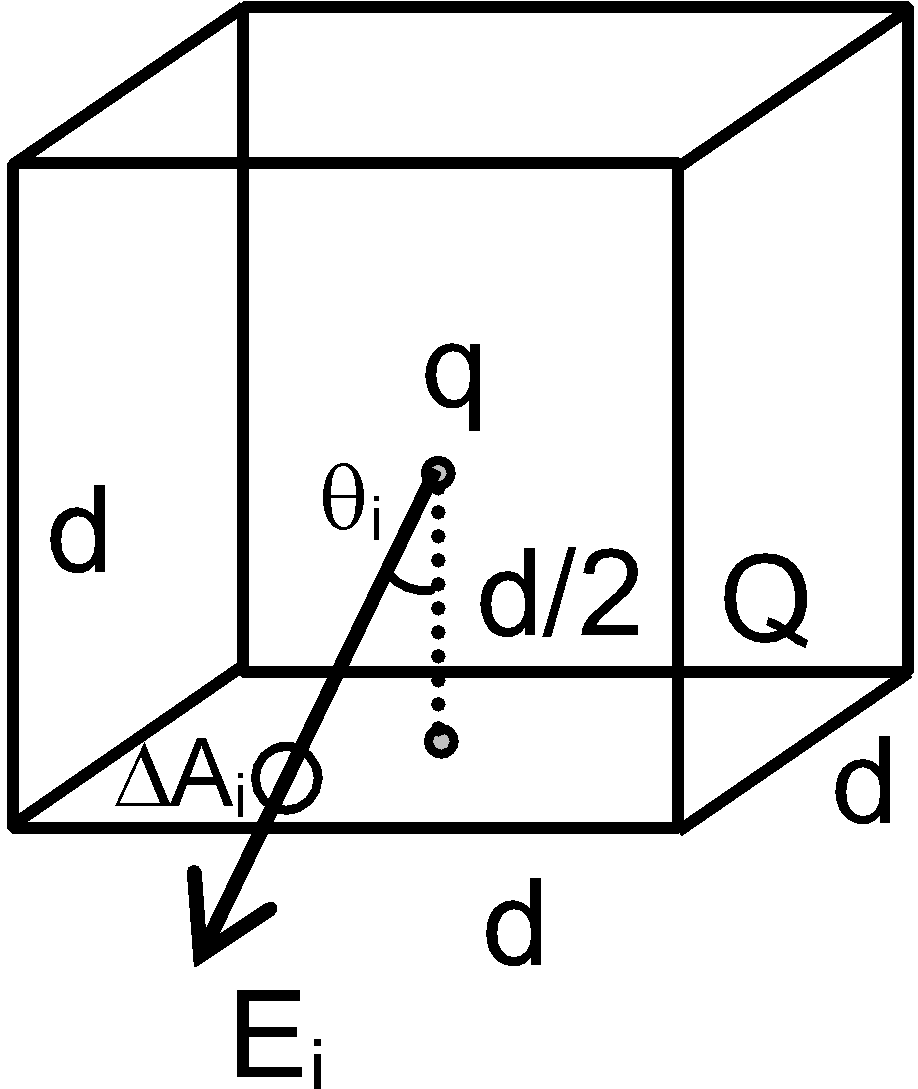
Using this and our previous observations, we calculate the magnitude of the force acting on the point
charge due to the presence of the charged insulating plate as
F = 
Prepare Smarter with CGP Edu
Get practice questions, solutions, and test series in one place.
Write a Review
Share your experience with this question and solution.
Commentary
Send your comment, doubt, correction, or feedback to admin.
Similar Questions
Explore conceptually related problems